They switched off Fable 5: the tool on a leash
ContenidoContents
A few days ago I wrote about Claude Fable 5 and gave it a podcast episode, Tools on a leash. The title was about something abstract: that the most powerful AI tools come with a leash —limits, oversight, dependency on whoever serves them—. I didn’t expect the leash to tighten so literally, or so fast.
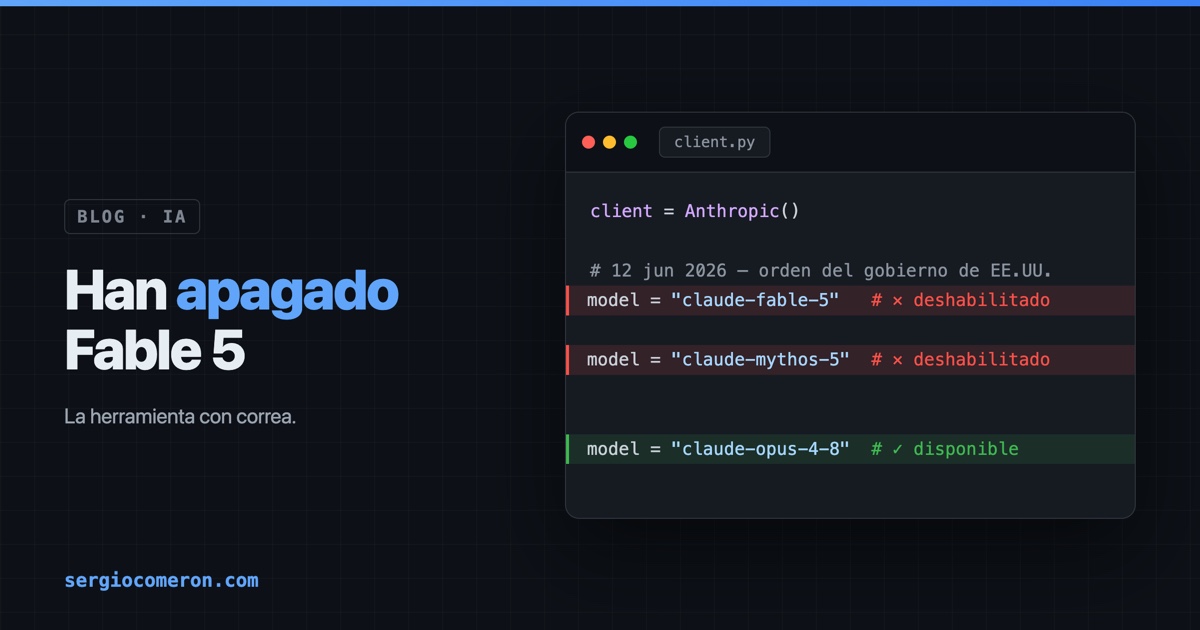
On Friday, June 12, at 5:21 p.m. Eastern, Anthropic received an order from the US government. The result: Fable 5 and Mythos 5, switched off. Not limited, not degraded: switched off for everyone. Fable 5 had launched three days earlier as “the most capable AI model available to the public.” It lasted a weekend.
What happened, plainly
The instrument was an export control order, justified on national security grounds. On paper it only barred access for foreign nationals —inside and outside the US, including Anthropic’s own foreign employees—. But given how that kind of control works, the only way to comply was to disable the models for absolutely everyone, US users included. The rest of Anthropic’s models keep working.
The reason the government gives is a narrow, non-universal jailbreak: a way to ask Fable 5 to analyze code to find vulnerabilities. Anthropic makes two reasonable points. One, that this capability is already available in other public models —it cites GPT-5.5— and is used daily by security professionals for defensive work. And two, that the government only provided verbal evidence, with no detail on the technical concern or the process.
Hold on to the nuance: this is not a proven technical flaw in the tool. It’s an administrative decision that the very company building the tool considers disproportionate and opaque. I don’t have to believe either side to draw the lesson I care about.
The part that affects me
I’m a developer, not a geopolitical analyst. What strikes me here isn’t the politics: it’s what it means for anyone who builds on top of one of these tools.
For years, the risk of depending on a closed service was told in the abstract: “what if they raise the price,” “what if they change the terms,” “what if they deprecate it.” This is the fast, brutal version of that risk. One morning the model your workflow is built on is the most capable on the market; by the afternoon it returns an error and there’s nothing you can do. Not because you did something wrong, not even because the company decided to: because a third party above it pressed a button.
That’s the leash. You don’t see it when things are fine. You feel it the day it pulls.
This isn’t about Anthropic, or Trump
It’d be a mistake to read this as “Anthropic bad” or as an episode of US politics. The subject of the sentence is interchangeable. Tomorrow it could be another company, another government, another pretext —a sanction, a lawsuit, a reorg, a change of strategy after an IPO—. The pattern is the same: a capability critical to your work lives in a box you don’t control and someone else can close.
You don’t even have to cross the Atlantic to see it. This very week, Apple announced that its new Siri —rebuilt on a custom version of Gemini— won’t reach iPhones in the European Union at the iOS 27 launch. Apple blames the Digital Markets Act; the European Commission shot back that it’s a voluntary business decision, not a legal obligation. And that’s the interesting part: for the 450 million European users left without the feature —me among them— it makes no difference whose fault it is. The effect is identical, whether it’s a government acting on national security or a regulator and a company passing the blame back and forth: the tool, switched on somewhere else, is switched off for you.
And the more capable and indispensable the tool becomes, the more it’s worth someone’s while to control it, and the more it hurts when it disappears. Power and fragility grow together.
And yet, here I am
The honest thing is to admit I’m the first one who doesn’t practice what he preaches. I’m pretty much married to Anthropic: I use its models every day, my whole workflow is built around them, and switching would cost more than I care to admit. I know what the prudent version looks like —don’t tie yourself to a single provider, keep a self-hostable alternative— and I still don’t do it. This week is, above all, an uncomfortable reminder: I’m wearing the leash too, and for now I’d rather not look at it.
One last irony
The bitterest part of the case is what caused it. Anthropic built much of its identity on safety: warning about how dangerous its models can be, keeping Mythos restricted to a handful of organizations. Those same warnings seem to have attracted exactly the scrutiny that now switches off its product. Warning that your tool is powerful and dangerous works wonderfully as marketing —until someone with authority takes you at your word.
The most dangerous tool for someone who builds isn’t the one that fails. It’s the one you let become indispensable without a plan for the day it’s taken away.