Claude Fable 5: the most powerful model I can use… and it comes on a leash
ContenidoContents
Today Anthropic dropped Claude Fable 5, and I’m writing this with the very tool I’m talking about, because I code with Claude almost every day. So I won’t play neutral reporter: I’ll tell you what I make of this from the seat of someone who leans on these models almost every day to get things done.
And the first impression is odd: it’s, at once, the most powerful thing Anthropic lets me use… and the thing they seem most nervous to have released.
What it is, no fluff
Fable 5 is the public version of something Anthropic calls Mythos, its most advanced class of models. Mythos had been on restricted access since April —chosen partners only, “for cybersecurity reasons”— and what opened to the public today is this safeguarded variant. The full version, Mythos 5, stays reserved for critical-infrastructure organizations.
Translation: they’ve handed us the fast car, but with the limiter on. And that, right off the bat, says a lot about where we are.
What I care about: does it code better?
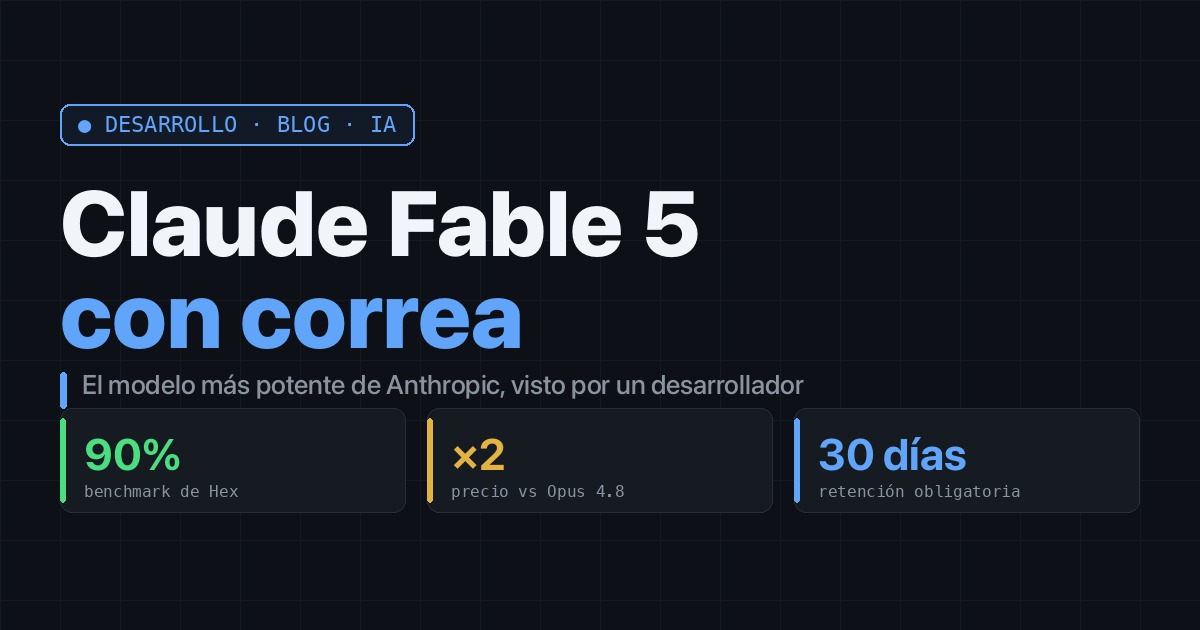
This is where my eyes light up. The first numbers going around aren’t lukewarm: it’s the first model to hit 90% on the Hex benchmark, there are teams saying it builds complete apps in a single shot and that its tool-chaining is outstanding, and others claiming it “beats everyone else” on UI design and code.
If half of that survives contact with my day-to-day —which is where many benchmarks fall apart— we’re talking about a real jump. Not “answers a bit better”, but “builds in one pass something that used to take three or four round-trips”. For anyone who works with this, that difference shows up in hours, not nuances.
But, and here comes the first handbrake…
The price: double Opus
Fable 5 costs ten dollars per million input tokens and fifty per million output. Double Opus 4.8, which is what I normally use.
That sounds abstract until you’ve spent a month billing API calls. Double the price isn’t a detail: it’s the difference between using it for everything and using it only when it truly pays off. And that, I think, will be the conversation of the coming weeks in every team already watching its AI spend. Not “is it better?”, but “is it twice as better?”.
For now it’s included at no extra cost in paid plans until June 22nd; from the 23rd it switches to separate usage credits. That said, Anthropic says it’s temporary and that it wants to bring it back into the regular plans as soon as possible —we’ll see—. So you’ve got two weeks of all-you-can-eat to form an opinion before it starts to hurt.
The part that nags at me
And now the uncomfortable bit, which I can’t ignore.
Fable 5 lands just days after Anthropic itself publicly called for a “coordinated brake” on frontier AI development, warning that these systems are getting close to improving themselves without us in the loop. I already mentioned it here and on the podcast. And now… they ship their most powerful model. Warn about the fire and sell lighters, all in the same month.
They justify it with safeguards, and to be fair they’re not for show:
- On sensitive topics —cybersecurity, biology, chemistry, copying the model itself— Fable refuses to answer and routes you to Opus 4.8. They say 95% of sessions run without ever hitting that brake.
- They ran over a thousand hours of bug bounty hunting for jailbreaks and found no universal one.
- And the one that makes me think most: they impose a mandatory 30-day retention of all traffic, even on customers who had zero-retention agreements. They promise not to train on it, only to use it to defend against new attacks.
That last one hits close. I’m fairly fussy about where data ends up. Having to accept that, to use the top model, they’ll keep what you send it for a month —no opt-out— is a toll that wasn’t there before, and one worth reading twice if what you’re sending isn’t trivial.
So, will I use it?
With my head on. I’ll take advantage of these two free weeks to throw at it the tasks where Opus stalls —big one-sitting builds, heavy refactors, UI design— and see if the jump is real. If it is, it earns a spot for the serious work; for the daily grind, a cheaper model will probably still make more sense.
But what I’m left with, above all, is a background feeling. I increasingly work with tools more capable than their own creators are comfortable with: with a limiter, an emergency brake, the camera rolling just in case. It’s not my paranoia; it’s the design they chose. And the fact that the tool I make a living with ships, out of the box, with so many warnings… says something about the ground we’re standing on.
For now, I’m opening it. But reading the fine print.