Why I shut down my daily AI podcast
ContenidoContents
A few weeks ago I wrote about how I built two AI-generated podcasts: El podcast de Sergio, a topical show, and El informativo de Sergio, a daily news bulletin. In that post I said, with some pride, that I could “publish a daily bulletin without any effort.”
I’ve shut it down. And I want to explain why, because the reason isn’t what anyone who has built an automation pipeline would expect.
It was never really a product
For me, the bulletin was mostly an excuse to learn how to automate a full production chain: find the topic, write the script, synthesize the voices, assemble the audio and publish to Apple Podcasts — end to end, without touching anything by hand. That was the real goal. The product was the by-product.
And once I’d learned that — the thing I actually wanted out of it — keeping it running on inertia made little sense. The experiment had served its purpose.
The problem wasn’t technical
When you build something like this, you assume the risk lives in the machine: ElevenLabs failing, the feed breaking, Apple Podcasts losing the RSS, the 7 a.m. script dying one morning. Those problems are real, but they all have fixes.
The automated part worked. The agent found the news, wrote the script, synthesized the voices, assembled the MP3 and updated the feed. Apple picked it up on its own. The marginal cost of one more episode was, literally, zero effort on my part.
And that was exactly the problem.
Automation removes the cost of producing, not the cost of meaning
A daily bulletin makes an implicit promise: something happened today that’s worth your time. The pipeline doesn’t keep that promise. It’s kept by the judgment that there is, genuinely, something to say.
When producing is free, the temptation is to produce always. But an AI-generated news roundup, published every day because it’s scheduled and not because anything mattered, isn’t information — it’s noise with a nice voice. I wasn’t adding a take you couldn’t already find in a hundred places. I was filling a slot in the calendar, not saying anything.
AI had removed the cost of producing. It hadn’t removed — and couldn’t — the cost of meaning: having something worth saying. Without that, the daily cadence only proved the system was still alive.
A frozen daily show looks worse than nothing
One detail weighed heavily. A topical podcast that ships when there’s a topic can go silent for three weeks and nothing happens: nobody expects a schedule. But a daily bulletin is a format with a frequency baked into its name. The day you stop publishing it, the last episode starts to smell of abandonment. A frozen daily feed doesn’t say “on pause,” it says “nobody lives here anymore.”
So the real choice wasn’t “do I keep publishing it or let it die slowly?” It was “do I keep it alive by force forever, or close it cleanly now?”
How to close a podcast properly
Closing isn’t deleting. Deleting breaks links, leaves a 404 on every episode someone shared, and punishes whoever arrived late. A clean shutdown respects what was published. Here’s what I did:
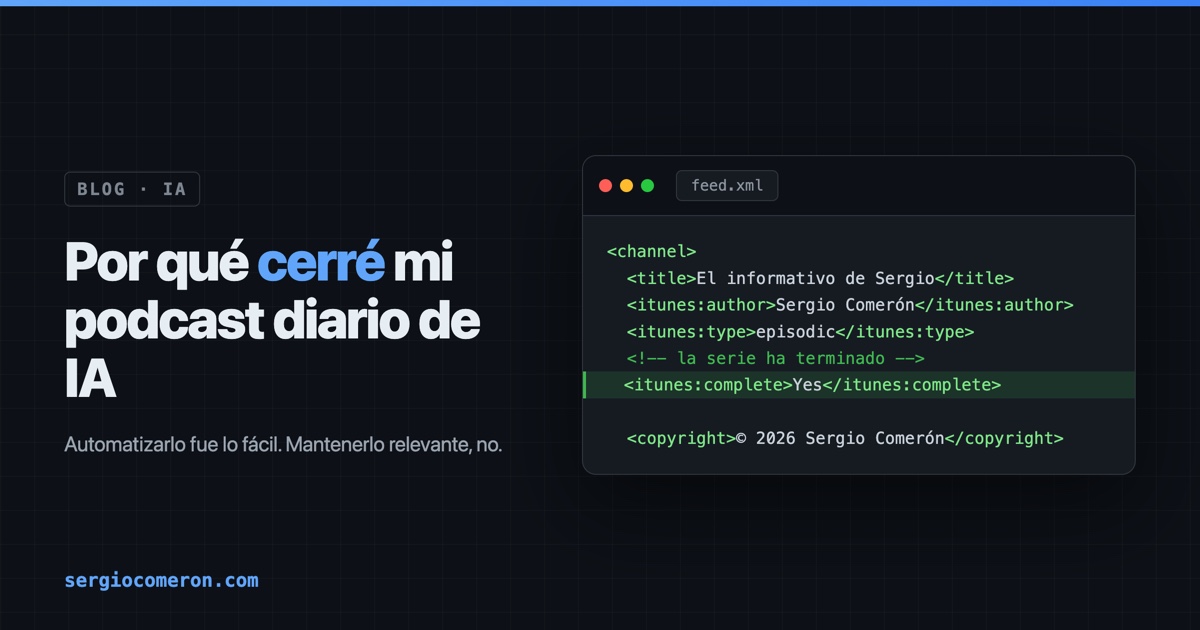
- Mark the feed as complete. In the RSS,
<itunes:complete>Yes</itunes:complete>tells Apple Podcasts there won’t be more episodes. The series reads as finished, not broken. - Keep the episodes. The MP3s, the cover art and the feed
<item>s stay where they were. Every link anyone shared still works. - Redirect the section. The old bulletin landing page now redirects to the podcast’s. No orphan pages.
- Clean up the crumbs. Out of the
sitemap.xml, the navigation, thellms.txtand the “what I’m doing now” page. What no longer exists shouldn’t keep advertising itself. - Keep the analytics alive. The historical downloads are still my data; the dashboard that reads them stayed untouched.
The result: anyone with a saved episode can still listen, Apple knows the story ended, and the site doesn’t drag a corpse around.
What’s still alive
El podcast de Sergio — the topical one — continues. And it continues precisely because its rule is the opposite: it ships when there’s something to say, not when it’s due. That constraint, which looks like a weakness next to an automated daily, turned out to be its greatest strength. Every episode exists because there was a topic, not because the calendar demanded one.
The lesson
Building the bulletin gave me exactly what I was after: learning to automate a production pipeline end to end. That was the goal, and it was met. Shutting it down taught me something I didn’t expect: just because you can automate producing something doesn’t mean you should keep it running. Once the thing you set out to learn is learned, keeping the experiment alive just to avoid switching it off is inertia dressed up as consistency. The question isn’t “can I keep publishing this effortlessly?” It’s “does this format deserve to keep existing?”
Sometimes the most mature product decision is to switch off what you built. Especially when building it was the easy part.