Claude Opus 5 is here: frontier at half the price
ContenidoContents
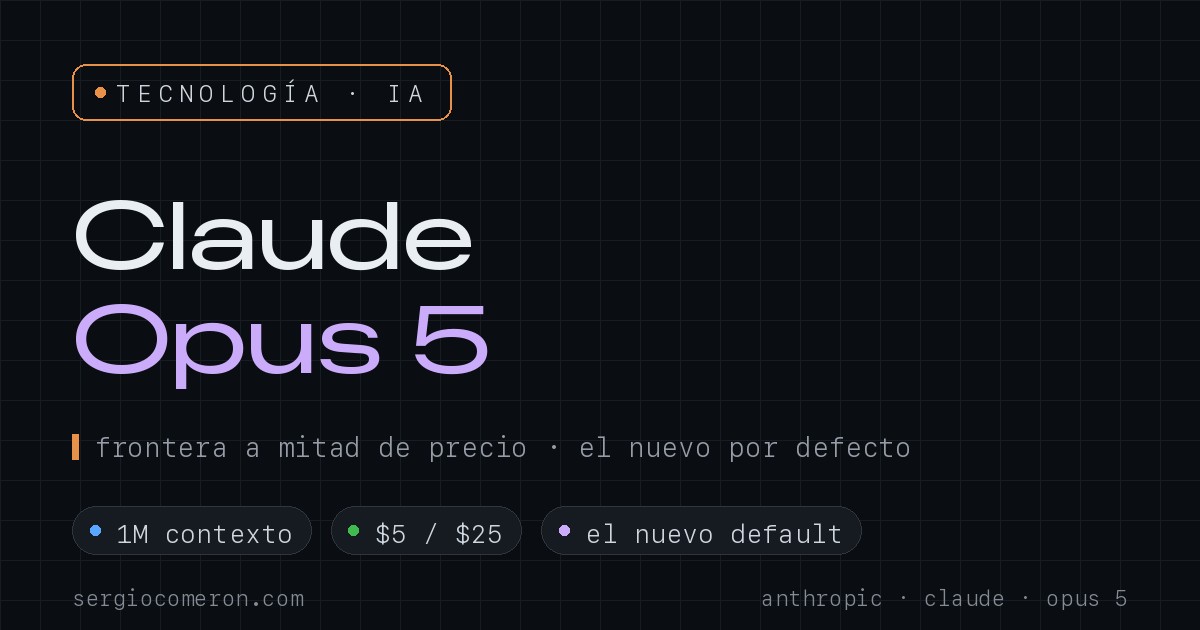
Anthropic just launched Claude Opus 5, and the headline isn’t so much “it’s smarter” —it is— as how much that intelligence costs: Opus 5 gets close to the capability of Fable 5, its top-tier model, but at half the price, and it costs the same as the Opus 4.8 it replaces.
The numbers, plainly
- Model ID:
claude-opus-5. - Price: $5 per million input tokens and $25 output. Identical to Opus 4.8, and half of Fable 5 ($10/$50).
- Context: 1 million tokens (both the default and the maximum).
- Output: up to 128k tokens.
- Knowledge cutoff: May 2026.
And it becomes the default model: the one Anthropic recommends out of the gate, and the one that now leads on Claude Max and Pro. Anthropic says it sets new highs across several benchmarks —a striking 30.2% on ARC-AGI-3, nearly four times GPT-5.6 Sol— while acknowledging it still trails Mythos 5 on cybersecurity tasks.
The practical part: a dial for your bill
What interests me most isn’t the benchmark, it’s the effort control. Opus 5 has five levels —low, medium, high, xhigh, max— that decide how much the model “thinks” before answering, and therefore how many tokens you spend. At low and medium it performs very well for a fraction of the cost and latency; you save xhigh/max for the genuinely hard stuff.
It’s literally a dial: the same frontier-grade intelligence, and you decide per task whether you pay for depth or for speed. For anyone building products with AI, being able to move that knob without switching models matters as much as the capability jump itself.
If you build with AI: what changes
A couple of things worth checking if you integrate the API:
- Thinking is on by default. On Opus 4.8 it didn’t think unless you asked; on Opus 5 it does, and the effort level tunes how much. Since
max_tokenscaps the total (thinking + response), revisit that value for flows that previously ran without thinking. - Breaking change: disabling thinking (
thinking: disabled) is only accepted at efforthighor below; withxhighormaxit returns a 400 error. - Details that help: the minimum to cache a prompt drops to 512 tokens (from 1,024), and you can now add or remove tools mid-conversation without breaking the cache (in beta).
- Migrating is almost free: change the ID from
claude-opus-4-8toclaude-opus-5and review those two behavior changes.
Behavior changes (even if you touch no code)
Opus 5 feels different: default responses run longer, it narrates its progress more in agentic tasks, delegates to subagents more readily, and —importantly— verifies its own work without being asked. If you carry over instructions like “add a final verification step” from earlier models, drop them: on Opus 5 they cause over-verification.
What it means
For me, the read is simple: Opus 5 becomes the reasonable “default.” Before, you had to choose between paying for the top tier (Fable 5) or settling for a step below; now you get near-frontier capability at Opus pricing, with a dial to tune cost per task. For those of us who build things with AI —from a Moodle question generator to agents that loop on their own— this lowers the bar for “when can I afford the good model.”
This isn’t an incremental update in disguise: it’s Anthropic pressing exactly where GPT-5.6 and the Chinese models press too, the cost per useful token. And that, in the end, is what decides what you can build.
Sources: Anthropic — What’s new in Claude Opus 5, Models overview, Fortune, VentureBeat.